
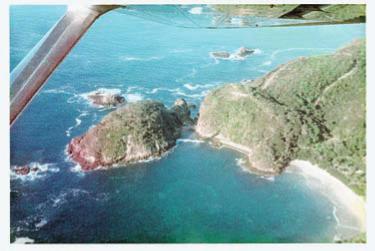
“It was the most beautiful day in the world… Gorgeous! Divine! Green hills, blue
ocean and white beaches. Everything was perfect.”
Years later, this is how Luis de Rivera—who had accompanied Gian Franco
Brignone on that fateful trip—would remember the first time they saw the Careyes
coast. They had gotten an early start, aboard a tiny, single-engine white Cessna 172
with a burgundy stripe on the tail, flown by an American pilot who was destined to live
more than a hundred years.
Brignone was scouting the Mexican coast for a place to retire from his activ-
ities in France. He was fed up with Europe, he said. De Rivera insisted on taking him
to see some beaches he’d discovered a year or so earlier, north of Manzanillo. They were
in an area that had remained untouched over the years, cut off from the rest of the
country. But Gian Franco did not appear convinced.
“It took some time,” Luis continues. “But on the last day, he said, ‘I’m going to
fly to Puerto Vallarta. Why don’t you come along and show me your famous little
beaches?’” It was July 2, 1968, the day of the Visitation of the Virgin.
They took off from a runway in Manzanillo—the airport didn’t exist yet. They
began flying northwest, passing Cihuatlán, Melaque and Barra de Navidad, with no idea
that this stretch of coastline had been visited back in the seventeenth century by car-
avels that had anchored there on their way to the Philippines. Ahead, they saw El
Tamarindo peninsula covered with vegetation, followed by the fishermen’s palm hous-
es in La Manzanilla. Beyond the mountains, they could see the Tenacatita mangroves.
Thirty minutes later, they were at the beaches of Careyes, named for the
hawksbill of carey sea turtles that frequented the small, rocky beaches along the coast. It
was impossible to land, so they circled the place a couple of times, and then continued
on to Puerto Vallarta. Gian Franco had an unsettled, mesmerized look in his eyes when
they finally landed. After helping his wife Consuelo off the plane, he got back on board
with Luis to fly over Careyes again.
Brignone marveled at what he saw. “How much would this cost?” he asked. “I
don’t know,” Luis answered. “But here you need to have cash in hand if you want to
close a deal.” Gian Franco told him to buy land north and south of the place. This com-
prised several kilometers of coastline—hundreds of hectares of jungle, mangrove swamps,
cliffs and beaches.
Once they returned to Puerto Vallarta, Gian Franco jotted down Luis’s bank
account number in Manzanillo. “Don’t forget to buy,” he repeated. Luis didn’t pay
much attention to him, because, he says, the Spanish haven’t taken the Italians seri-
ously since the Spanish Civil War: “In the battle of Guadalajara, when we yelled
¡A la
bayoneta!
(‘Use your bayonets!’), they thought we were saying,
¡A la camioneta!
(‘To the
truck!’), and started running. We almost lost the war on account of them.”
Gian Franco went back to Europe and Luis forgot about the matter, but he
was quickly reminded of it: “A week later, two million dollars landed in my account,
and I said to myself: I have no choice but to buy. The Italians turned out to be more
reckless than I had thought.”
Careyes remains a wild, virtually uninhabit
territory, stretching along twelve kilometer
Pacific shoreline—about 1500 hectares
of jungle, mangroves, cliffs and beaches on
Jalisco coast. From the air, the view has not
changed much since Gian Franco Brignone
inspired to build the first oceanfront home
there almost forty years ago.
Brignone would always clearly recall the fir
time he saw the Careyes shoreline. “It was
at first sight. An unconditional love, one th
continues to this day. No woman or child
of mine had ever inspired so much love in
He was forty-two years old and about to
embark on an adventure unlike anything he
ever experienced before.